The Elite Investment Gap
Imagine you could see what a group made up of the 1,500 people closest to ultimate executive power in the U.S. invested in. Imagine that, within the same sector, 95 of them chose to buy shares in one company, but only 3 chose to buy in another. Which of those stocks would you say was the safer bet? Which of these companies is more likely to be going somewhere good any time soon? These are the people with some of the best access to inside information on potential legal and regulatory changes. Would you bet against them?
This isn’t hypothetical.
If you believe the hype, psychedelic medicalisation going mainstream is just around the corner. Lots of ink (or, pixels, at least) has been spilt on this idea. Lots of people are invested in this. For some, like the dedicated chancers in r/shroomstocks, this is quite literal. They stake real money, sometimes considerable chunks of their savings, betting that these stocks will one day radically increase in price.
For others, it’s indirect or symbolic. But don’t be fooled into thinking that this makes it less important to them, or that there are no financial implications. Many participants in the cottage industries of microdosing education, psychedelic retreats and integration coaching regularly appeal to the supposedly immanent marketisation of visionary molecules. They do this to reinforce narratives of psychedelic use being acceptable and to legitimise the goods and services they’re selling. (That this is firmly aimed at legitimacy under capitalism is noteworthy, but that’s a discussion for another day.)
We’ve nursed this feeling of immanent change for years. The longer it goes on, it seems, the more desperately we tell ourselves ‘any day now.’
I think we have a little longer to wait.
Rather than reading the tea leaves of share prices or trying to decipher the rambling squawks of RFK jr. as he attempts to mind-meld with Joe Rogan, I’m going to point to something that might be a bit speculative, but that I think is far more indicative and grounded in real data: the shares and investments of the people Trump tapped on the shoulder to enact his agenda.
ProPublica publishes and maintains a database of the financial disclosures of 15,00 top Trump appointees. How up-to-date this information is depends on exactly what documentation was triggered by a transaction and the timing of yearly reports. At this point we have pretty good information for 2024, but up to quite recently where a share transaction was above $1000 USD.
Elite Insider Investments
So, let’s look. How many of the people in such close proximity to executive power in the US hold Compass Pathways shares?
Three. Actually, when you look at the details, it’s only one. Of the three hits in that search, one, Andrew Gradison, Acting Assistant Secretary, Department of Health & Human Services, sold his shares last year. And Benjamin Black, Chief Executive Officer of the United States International Development, U.S. International Development Finance Corporation, doesn’t own these shares, his spouse does (and less than $1000 worth, at that.)
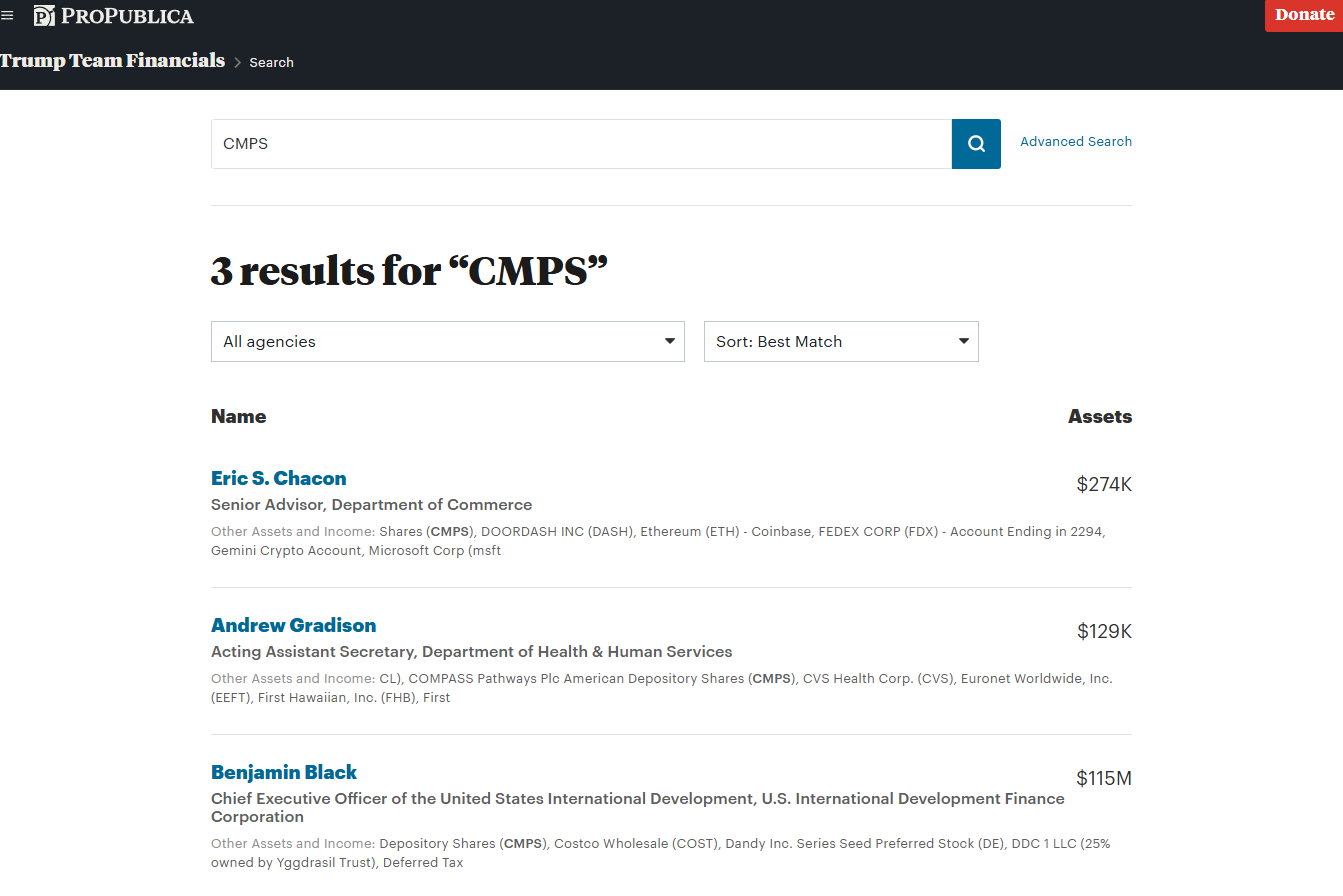
Only Eric S. Chacon, Senior Advisor, Department of Commerce, still has CMPS shares listed.
How about AtaiBeckley? Lots of apparently exciting drugs in an IP-protected pipeline. Perennially undervalued (but remember, this isn’t financial advice!) Has this attracted any investment from this elite group?
Just one, Emil George Michael, Under Secretary of Defense for Research and Engineering, Department of Defense. Michael has a modest investment of between $1001 and $15,000, via Nomadic Ventures brokerage. In a total portfolio valued at $121M–$277M+, I see this more as noise than anything else.
Nothing for GH Research or Cybin.
A single hit for MindMed/Definium, Nicholas A. Merrick, Ambassador to the Czech Republic, but only as part of a fund that invested in over 80 biotech businesses.
Now, you could object on the grounds that these people might want to keep their investments secret due to public perceptions. Maybe. But this is the same group that enthusiastically invests and participates in cryptocurrency and arms manufacturing. So I’m not sure how much they care about what regular folk think.
Nor is it that no appointees will invest in pharmaceutical companies. Searching for Eli Lilly shares returns 100 results, including Mehmet Oz. Likewise, searching heavy hitters such as Johnson & Johnson and AbbVie return 95 and 75 results respectively.
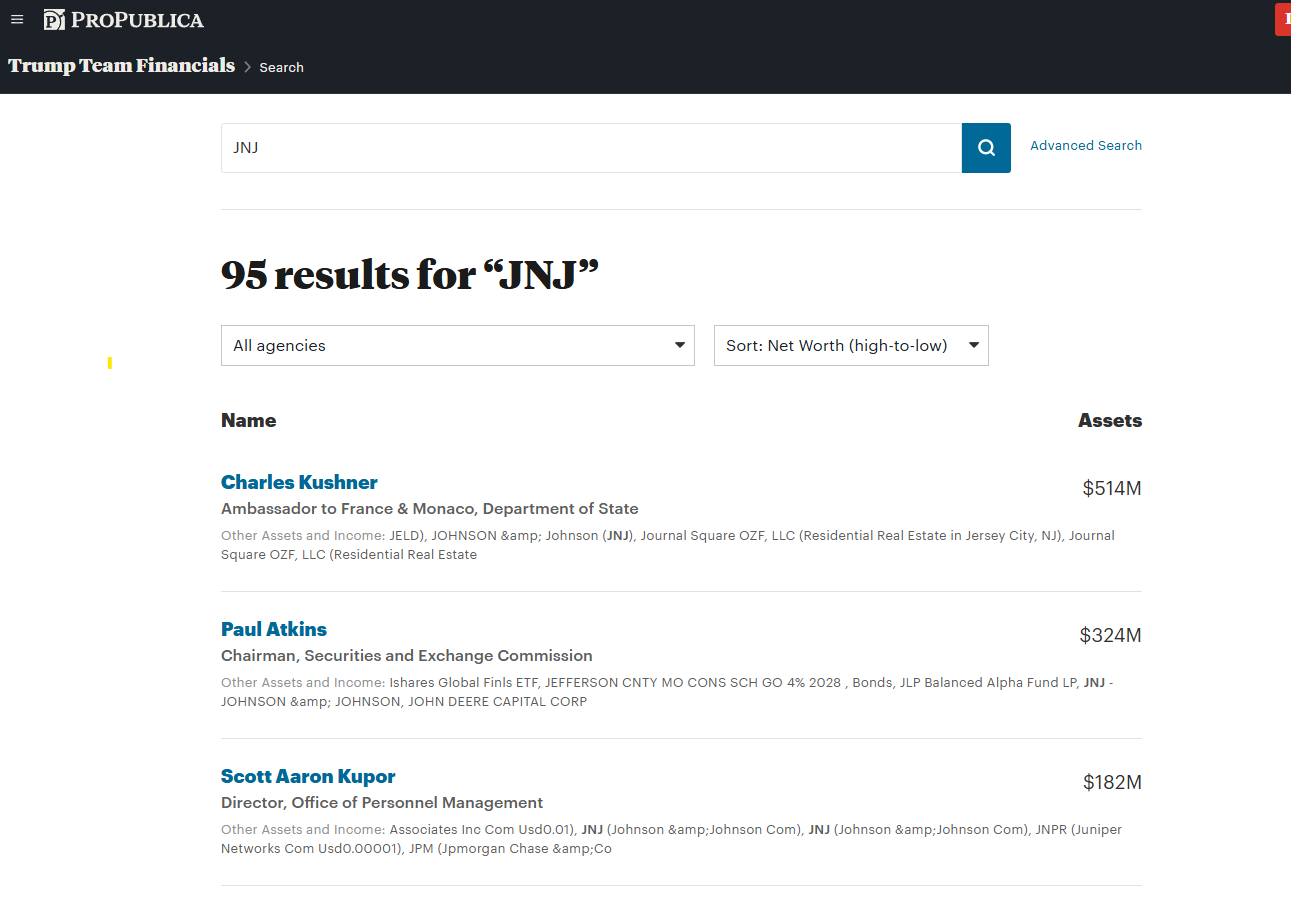
This raises an interesting side note: where these people do have exposure to psychedelic investments, it’s almost always through mature companies with multiple income streams. If medical bretisilocin never goes to market, AbbVie’s bottom line won’t change much. Likewise, even though Spravato may have pulled in $1.7 billion in sales last year, J&J’s full-year sales were $94.19 billion. If they lost Spravato, that would hurt, but the financial pain would be temporary, and investors would easily ride it out.
But I digress.
It’s also the case that these records only capture investments that appointees have not hidden through the use of qualified blind trusts or other less salubrious methods. So it’s possible that more of these people hold psychedelic stocks than the official record shows. If that was the case though, we’d also have to ask ourselves why that would be.
Why Won’t They Buy?
If these records are at least roughly accurate, that long awaited psychedelic financial breakout isn’t coming any time soon. Or if it is, it isn’t coming from the likes of AtaiBeckely or Definium.
Think about it: Inveterate stock market gamblers, with the connections to know about relevant legal changes before they are public, worth millions or even billions, by and large won’t invest in psychedelics.
It’s one thing to say that this indicates that approval and widespread sale of something like COMP360 or BPL-003 is a way off. But as to why this pattern of investment, or lack thereof, exists, might also be illuminating, if we can ever unpack what’s happening.
It’s not like this group is adverse to wild bets, especially via cryptocurrency. Heck, more people have money in Polkadot (DOT) than in Atai, Compass and MindMed combined. (For non-crypto folk, DOT is, IMO, one of the most deeply underperforming/utterly borked investments you could make, being only slightly better than Trump’s own memecoin.)
So maybe that’s part of the story: that the regulatory capture we’ve seen for crypto has not yet advanced to the same extent for psychedelics.
Either way, for whatever reason, Trump’s movers and shakers aren’t buying into the psychedelic renaissance, yet.
Moving forward, I think this warrants some attention over time, to see if a correlation emerges. If, for whatever reason, insider/elite confidence in psychedelic pharma grows, we should start to see that reflected in disclosure data.
Right now though, here’s my prediction: If we see these appointees start to buy up psychedelic stocks, then the mainstream and widespread commercialisation of psychedelics is on it’s way or happening already. If they don’t, then it’s not.
Time will tell.
Stay Ahead of the Psychedelic Curve
Every two weeks, I send The Ethical Trip, a newsletter containing:
Unique industry analysis
Philosophical explorations of politics, technology and culture
Practical tips on harm reduction, activism or psychedelic business
All delivered with a hint of dark humour.